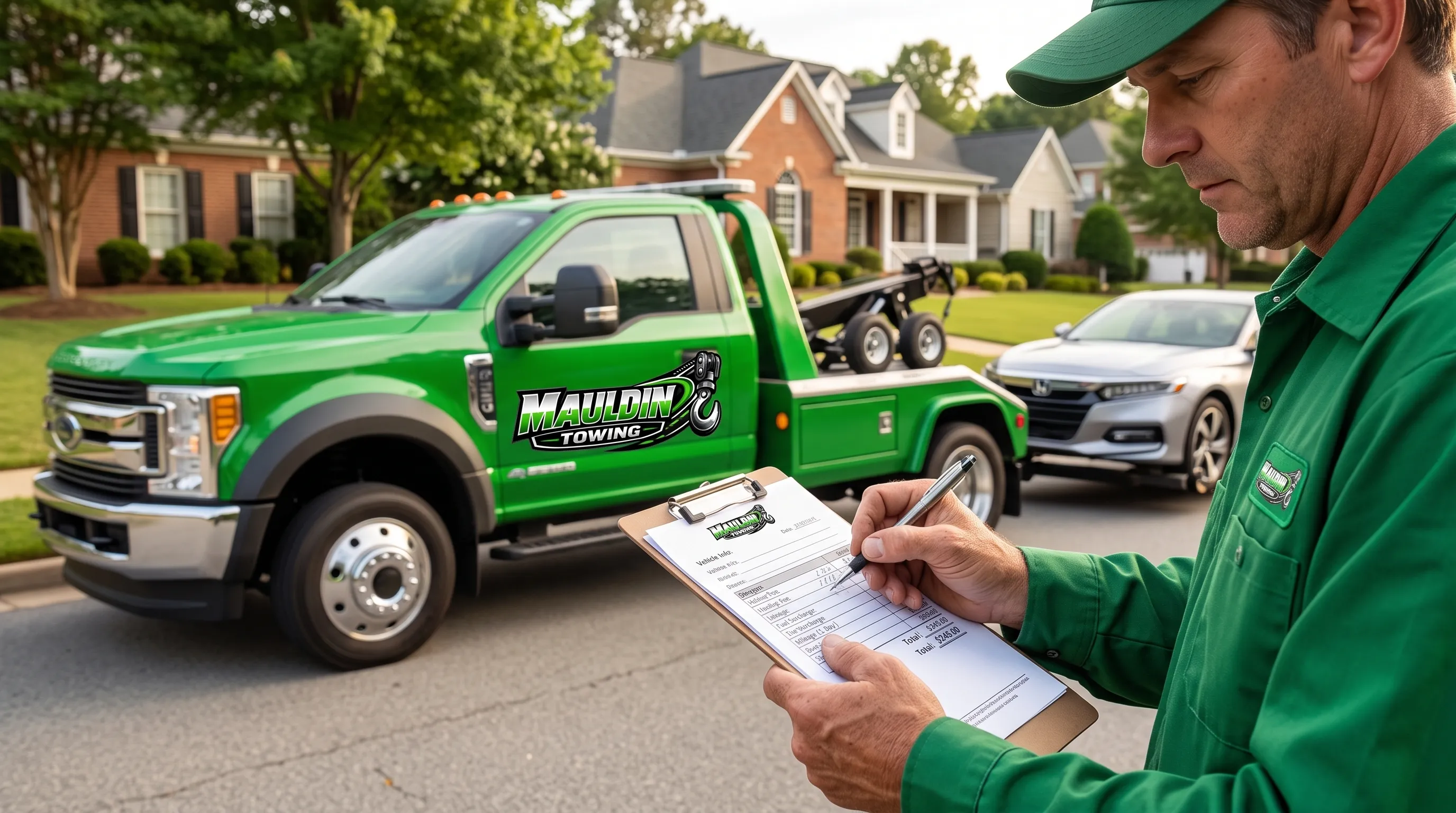
Quick answer: figure $75 to $150 for a routine local tow around Mauldin, that’s the hookup plus the first few miles, and then a per-mile charge kicks in after that. Where you land inside that range comes down to distance, what you’re driving, and whether the car’s sitting on a public road or a private lot. We don’t add a surcharge for calling at night, on a weekend, or on a holiday.
Nobody knows what a tow costs until dispatch says the number out loud. For some companies that’s deliberate. It shouldn’t be. AAA logged more than 27 million roadside service calls in 2024, and towing topped the list, roughly 48% of them, well ahead of dead batteries at around 26% (AAA Newsroom, April 2025). So if you’re reading this because your car won’t start on a Golden Strip street right now, here’s the actual breakdown, not the vague version.
Key Takeaways
- Local tows in the Mauldin area typically run $75-$150 for the hookup plus first few miles, then a per-mile rate after that.
- Vehicle type, distance, and public vs. private property all move the price. Time of day doesn’t, we charge the same rate day or night.
- South Carolina has no statewide fee cap, but state law requires notice and paperwork protections on non-consensual tows.
- Get an estimate before the truck arrives and an itemized receipt at drop-off, every time.
How much does a typical local tow cost in Mauldin?
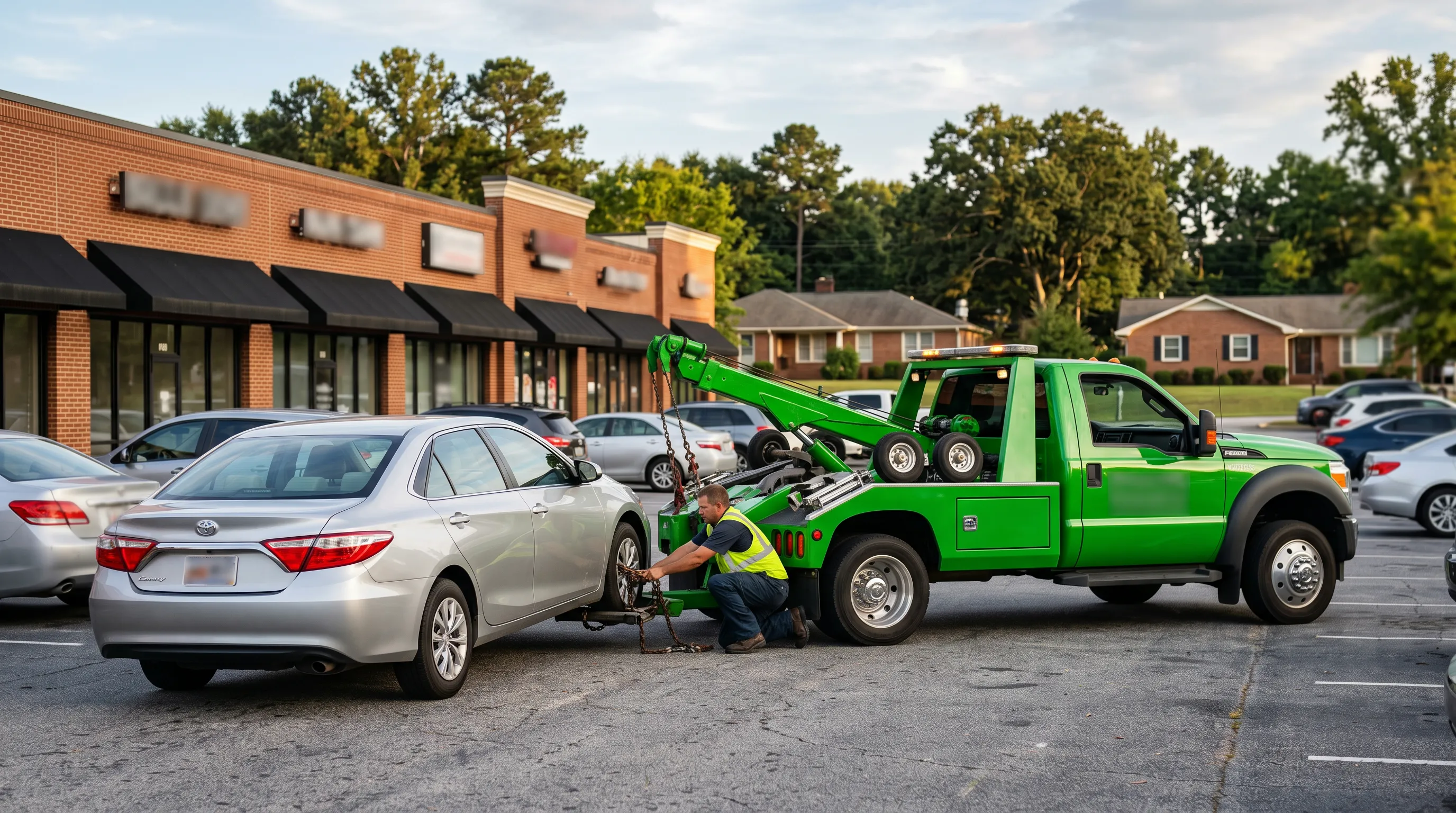
Most local tows land in the $75 to $150 range. That’s a base hookup fee covering the first several miles, then a per-mile rate once you’re past the included distance. Think of the base fee as paying for three things: the truck rolling out to you, the driver hooking everything up correctly, and a short haul to wherever the car needs to go.
Where you land in that range depends mostly on distance. A car parked a mile from our yard costs less to move than one broken down near the Fountain Inn line. Call at 2 p.m. on a Tuesday or 1 a.m. on a Saturday and the rate’s the same either way, we don’t add an after-hours or holiday premium the way a lot of towing companies do.
Why does long-distance towing cost more per mile?
Once a tow goes past the included local radius, mileage becomes the main driver of the total bill, and long-distance jobs are priced differently than a quick in-town hookup. If you need your car moved to a dealership in Greenville, a specialty shop across the state line, or back home after a road trip breakdown, expect a per-mile rate for every mile past the local zone, not a flat fee.
Our long-distance towing service quotes this upfront specifically so there’s no surprise total waiting at drop-off. Ask for the full per-mile rate and the estimated total mileage before the truck leaves, not after it arrives.
What else changes the price besides distance?
Distance explains most of the gap between a cheap tow and an expensive one, but a few other factors move the number too. Time of call isn’t one of them, that’s deliberate, not an oversight.
| Factor | How it typically moves the price |
|---|---|
| Vehicle type | Sedan is the baseline; trucks, SUVs, and EVs on a flatbed cost more |
| Distance | Local hookup fee covers a set radius, then per-mile after that |
| Property type | Private-lot tows add a release fee on top of the base tow charge |
| Vehicle class | Heavy-duty and commercial vehicles need a bigger truck and more time on scene |
What generic “average tow cost” numbers get wrong: most of the $75-$400 ranges circulating on towing-cost sites trace back to unsourced aggregator content, not an actual survey or study. The range in this guide reflects what actually gets dispatched in the Mauldin area, not a nationwide blend of rural mountain tows and dense-city minimums averaged together.
Vehicle type matters. A standard sedan is the baseline. Trucks, SUVs, and anything requiring a flatbed instead of a wheel-lift usually cost more, because flatbed trucks and the extra time to load safely cost the company more to run. EVs specifically should go on a flatbed every time, wheels fully off the ground, not a wheel-lift. Towing an EV with the wheels still turning can spin the drive motor unpowered, and manufacturer guidance warns that can mean serious, uninsured repair costs, potentially thousands of dollars (TFLcar, March 2025), which is one reason EV towing tends to run at the flatbed rate even for a short haul.
Heavy-duty and commercial vehicles cost more still, since they require a bigger truck, a different operator certification, and more time on scene. If you’re moving a box truck or a piece of equipment, expect a quote closer to our heavy-duty commercial towing pricing rather than standard passenger-car rates.
Private property tows work differently. If your car got towed out of a Five Forks or Woodruff Road parking lot for an unauthorized-parking violation, that’s a private property tow, and pricing there is often set by state statute and posted signage rather than a standard dispatch quote. Expect release fees on top of the tow itself, and confirm the total with the property’s contracted tow company before paying.
How do you avoid getting overcharged for a tow?
South Carolina doesn’t set one statewide dollar cap on towing fees. Protection against overcharging comes more from paperwork rights than a fixed price ceiling. State law requires a tow company to notify police within one hour of a non-consensual private-property tow. It also requires the company to send the registered owner formal notice by certified mail, with 30 days to reclaim the vehicle before further action (S.C. Code §§ 56-5-2525, 56-5-5630). Police-ordered tows on the South Carolina Highway Patrol’s rotation list do run under a published fee ceiling: roughly $251 for a light-duty tow and $352 for medium-duty, with an hourly rate for heavy-duty recovery (SCDPS Wrecker Regulations, fee schedule reviewed annually). That schedule is worth knowing as a rough benchmark even outside a police-ordered call.
It’s also worth knowing federal “junk fee” protection doesn’t cover towing. The FTC’s 2024 rule banning hidden fees on tickets and hotel bookings explicitly excluded towing after industry pushback. That’s despite the U.S. DOT’s own Federal Motor Carrier Safety Administration urging regulators to include it (FTC.gov, December 2024). That gap is exactly why predatory pricing still happens, especially with private property tows and after-hours calls from unfamiliar companies, and why a few habits matter more than the law alone.
A few habits go a long way here:
- Get the estimate before the truck shows up, not after the car’s already hooked to the frame. Any company worth calling can give you a real number, or at least a tight range, once they know the distance and what you drive.
- Ask for an itemized receipt when it’s over. Hookup fee, mileage, any surcharges, all broken out separately, not just one lump total.
- Watch for the bait-and-switch. A company that won’t quote a range up front, or one where the on-scene price suddenly jumps past what dispatch told you, is worth pushing back on before you hand over a card.
Does insurance or roadside coverage lower the cost?
Yes, if you have it, but how much depends on which kind of coverage you’re using. Auto policy roadside add-ons, manufacturer programs, and credit card benefits all handle towing costs differently, some reimburse after the fact, others dispatch through their own network. Our Golden Strip towing insurance guide breaks down which type of coverage you likely have and what paperwork you need for a clean reimbursement claim.
Without coverage, you’re paying the base rate out of pocket, which is exactly why getting a clear quote before the truck leaves matters more than it might seem in the moment.
Frequently asked questions
Is the price different for a tow after a car accident?
Not by much for the tow itself. Where it changes is the extras, scene time, winching a car out of a ditch, debris cleanup, the stuff a routine breakdown call never involves. Our accident recovery service breaks those out separately instead of folding them into the base fee where you’d never notice them.
Do you charge more for towing on nights or weekends?
No. Pricing is the same custom, upfront quote regardless of when you call, no overnight or holiday surcharge added after the fact. A lot of towing companies do charge more after hours, we just don’t.
Can I get a quote over the phone before I commit?
Yes, and you should ask for one. Give dispatch your location, where the car’s headed, and what you’re driving, and you’ll have a real number before the truck even leaves the yard.
Why did a private property tow cost more than I expected?
Probably a release fee stacked on top of the actual tow charge. That’s set by the property’s contracted towing company, not by us, and it catches people off guard constantly. Get the itemized breakdown before you pay, and check it against whatever’s posted on the lot signage.
The bottom line
Most local tows in the Mauldin area land in the $75 to $150 range for the hookup and first few miles, with mileage, vehicle type, and whether you’re on public or private property moving the number from there, no matter what time you call. Ask for a real estimate before the truck leaves, get an itemized receipt at the end, and you’ll never be stuck wondering what you actually paid for.