
Quick answer: towing coverage usually comes from one of three places — your auto policy’s roadside add-on, a manufacturer/dealership program, or a credit card benefit — and knowing which one you have, and whether it reimburses or dispatches directly, matters more than just knowing you’re “covered.”
If you commute daily across the Golden Strip, between Mauldin, Simpsonville, Fountain Inn, and into Greenville, you have probably wondered at some point whether a tow would actually be covered if you needed one. Most drivers find out the answer the hard way, mid-breakdown, scrolling through an insurance app trying to figure out what their policy actually pays for. Here is the plain-English version, worked out before you need it.
Key Takeaways
- Towing coverage usually comes from an auto policy add-on, a manufacturer program, or a credit card benefit — not all three, so check which one you actually have.
- Reimbursement-based coverage lets you call a local company directly; insurer dispatch can be slower during peak commute times.
- A clean claim needs an itemized receipt, the tow company’s contact info, your policy number, and accident photos if applicable.
- Check your per-incident cap and included mileage before you need a tow, not during one.
The three ways towing coverage usually shows up
Most drivers have access to towing coverage through one of three places, and they are not the same thing, even though people use “roadside assistance” to describe all of them.
Auto insurance roadside assistance add-on. This is a line item on your policy, usually a few dollars a month, that covers a set number of tows or roadside calls per year, often with a dollar cap per incident. It typically covers towing, jump starts, lockouts, flat tire changes, and fuel delivery, similar in scope to what our own roadside assistance service handles on site.
Manufacturer or dealership roadside programs. Newer vehicles, especially those still under the original warranty period, often include a few years of roadside assistance through the manufacturer rather than your insurance company. This is worth checking separately, because it can mean you have coverage even if you skipped the add-on on your auto policy.
Credit card and membership benefits. Some credit cards and auto club memberships include towing benefits, usually with a mileage limit or a per-incident dollar cap, and usually require you to pay upfront and submit for reimbursement rather than billing the tow company directly.
Why “does my insurance cover this” is the wrong first question
The more useful question is: how does my coverage actually pay out? Roadside assistance add-ons typically work one of two ways. Some let you call a dispatch line associated with the insurer, who then sends a contracted tow provider, meaning you have less control over who shows up or how fast. Others reimburse you after the fact, meaning you can call a local company you trust directly, pay at the time of service, and submit the receipt afterward.
For Golden Strip commuters, this distinction matters because response time is often the whole point. Waiting on an insurer’s own dispatch network to route your call through a call center, then wait for their contracted provider to become available, can take considerably longer than calling a local towing company directly, especially during peak commute windows when everyone’s insurer dispatch line is busy at once.
What you need for a clean reimbursement claim
If your coverage works on a reimbursement basis, the paperwork requirements are almost always the same short list:
- An itemized receipt showing the date, service performed, vehicle, and total charged
- The name and contact information of the towing company
- Your policy or membership number, ready before you call your insurer
- Photos of your vehicle’s condition at pickup, if the tow followed an accident rather than a mechanical breakdown
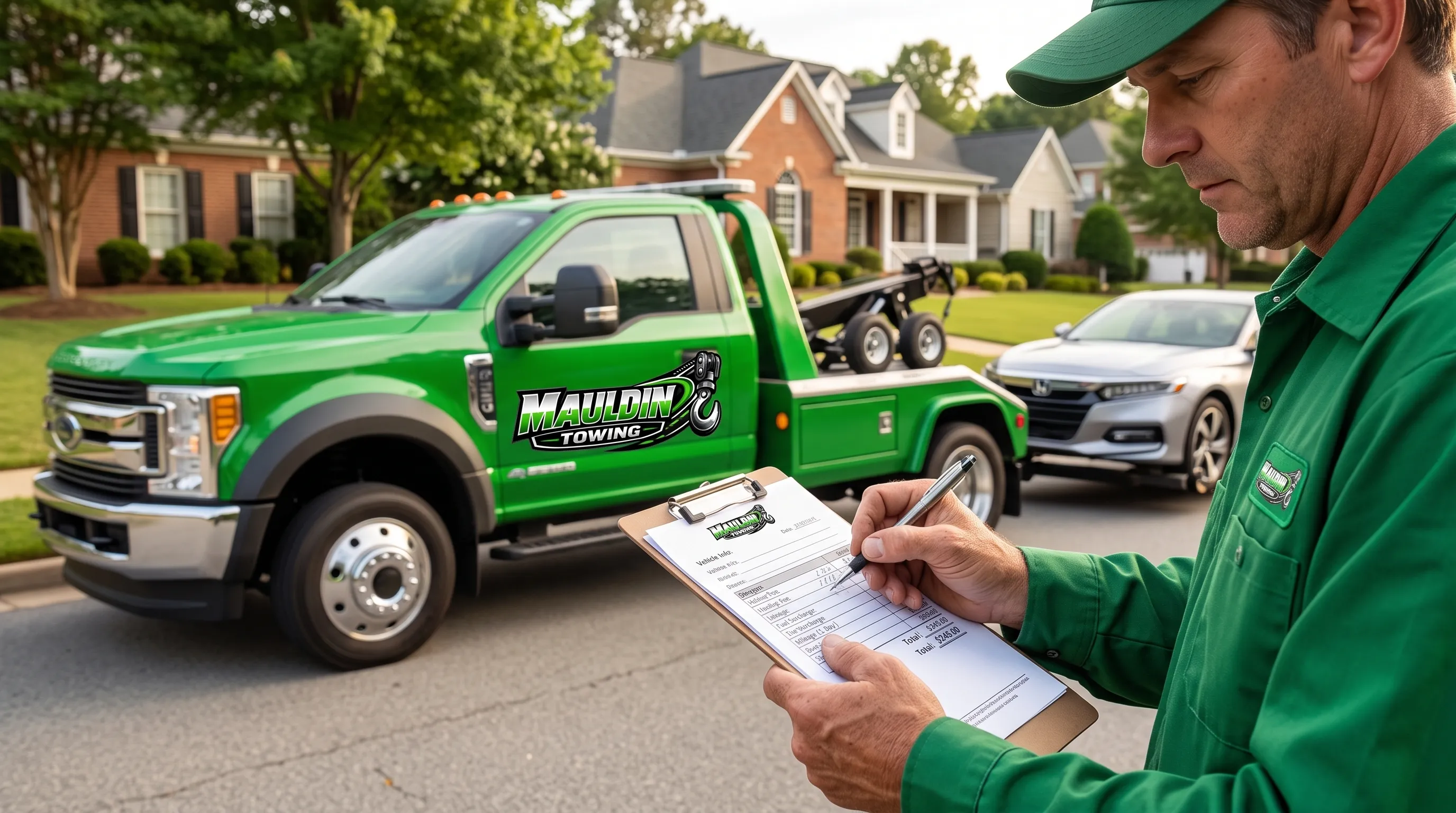
We provide a clear, itemized receipt on every call specifically because so many of our customers in Mauldin, Simpsonville, and Fountain Inn are submitting for reimbursement afterward. If your claim gets kicked back for missing documentation, it is almost always one of these four items, so it is worth double-checking before you file.
A common Golden Strip commuter mistake
Because so many people here drive the same stretch of road daily, between Mauldin and Simpsonville along Fairview Road, or Mauldin and Fountain Inn further south, a common mistake is assuming a reimbursement-based membership will always be cheaper than just calling a local tow company and paying out of pocket. That is not always true once you factor in per-incident caps, mileage limits past which you start paying overage fees, and the time cost of coordinating through a third-party dispatch line during a stressful moment.
Before you actually need a tow, it is worth pulling up your policy or membership terms once and checking three numbers: how many incidents you get per year, what the per-incident dollar cap is, and how many miles of towing distance are included before extra charges apply. Knowing those three numbers in advance turns a stressful roadside call into a simple math problem instead of a surprise.
Frequently asked questions
Do I have to use my insurer’s dispatch network, or can I call a local company directly? Depends on your coverage type. Reimbursement-based coverage lets you call a local company directly, pay at the time of service, and submit the receipt afterward. Insurer-dispatch coverage routes you through their own network instead, which can be slower during peak commute times.
What paperwork do I need for a reimbursement claim? An itemized receipt, the towing company’s contact information, your policy or membership number, and photos of the vehicle’s condition if the tow followed an accident. We provide a clear, itemized receipt on every call for exactly this reason.
Does my new car’s warranty cover towing? It might. Many newer vehicles include a few years of manufacturer or dealership roadside assistance separate from your auto insurance, worth checking even if you skipped the add-on on your policy.
What should I check on my policy before I actually need a tow? Three numbers: how many incidents you get per year, the per-incident dollar cap, and how many miles of towing distance are included before extra charges apply. Knowing those in advance turns a stressful roadside call into a simple math problem.
The bottom line for commuters in this corridor
Coverage exists in more places than most drivers realize, an insurance add-on, a manufacturer program, or a card benefit, but the details of how each one pays out vary enough that it is worth checking now rather than during a breakdown. And regardless of which coverage you are relying on, an itemized, honest receipt from the company doing the actual tow is the one document that makes every reimbursement path work.