
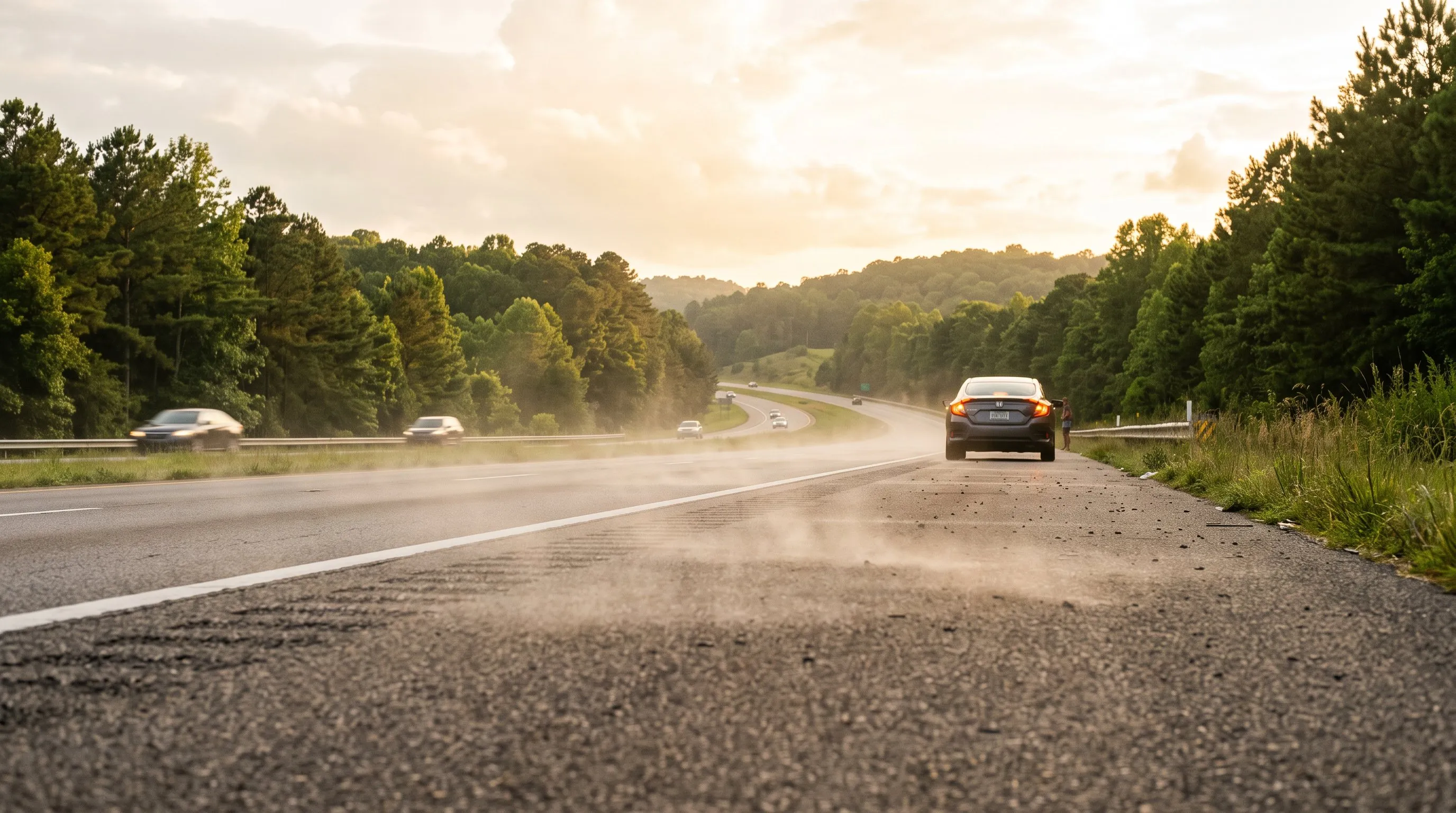
Quick answer: heat, not cold, is what actually strands most Upstate SC drivers this time of year — hot pavement weakens tires enough to blow out, and sustained high temperatures push a marginal cooling system past its limit. Both give a warning sign first, and both are easy to check before a long drive.
We already covered the winter side of this in our ice storm post — the season Upstate drivers are least prepared for. Heat is the mirror image: it’s not rare here, it’s most of the year, which means the damage builds up quietly over months instead of catching everyone in one bad week. AAA estimates roughly 7 million rescues nationwide every summer, more than any other season, and heat is the leading cause of battery failure, not cold (AAA). Tires and cooling systems take the rest of the hit.
Key Takeaways
- Heat causes more roadside calls nationally than any other season — AAA logs around 7 million summer rescues.
- Pavement can hit 140-150°F on a hot Upstate afternoon, which is hot enough to weaken tire rubber and trigger a blowout.
- Federal crash data shows tire-related crashes peak between May and October, not in ice or snow.
- A cooling system that’s fine in mild weather can overheat under sustained heat and highway speed — check coolant and hoses before a long drive, not after the gauge climbs.
- Underinflated tires run hotter and fail faster in the heat — check pressure against the driver’s-door sticker, not the tire’s sidewall.
Why hot pavement is harder on tires than most drivers realize
Air temperature is only part of the story. Pavement itself runs far hotter than the air above it, and on a sunny Upstate afternoon it can climb to 140-150°F, well past what’s shown on a car’s dashboard thermometer (NHTSA-cited pavement data via AAA). Sustained heat like that breaks down the rubber compound and the internal structure of a tire over a long drive, which is exactly why federal crash data shows tire-related crashes peak between May and October rather than during winter weather (NHTSA, TireWise).
Underinflation makes it worse. A tire that’s low on air flexes more with every rotation, and that flexing generates its own heat on top of what the pavement is already adding. That combination, already-hot pavement plus an underinflated tire working harder than it should, is the specific setup behind most late-summer blowouts we see on I-385 and I-85, where sustained highway speed gives heat the most time to build before anything gives out.
Why overheating spikes in sustained heat
A cooling system that quietly gets your car through mild weather can fall behind once outside temperatures and highway speeds both push it for hours at a stretch. Low coolant is the most common cause and the easiest one to catch, checking the reservoir level takes under a minute with the engine cold. A weak hose or an aging thermostat that never caused a problem in spring can also finally give out once it’s asked to work this hard for weeks on end, which is why we see more overheating calls stack up the longer a hot stretch runs, not just on the single hottest day.
If your temperature gauge starts climbing, the move is the same one we give every season: stop driving on it. Pull off at the next safe shoulder or exit, shut the engine off, and call rather than pushing on and turning a coolant top-off into a blown head gasket.
What to check before a long summer drive
- Tire pressure, checked cold. Match the number on the driver’s-door sticker, not the tire’s sidewall, and check it before driving rather than after the tire’s already warmed up on the road.
- Tire tread. Worn tread combined with heat is a faster path to a blowout than either one alone. Below 4/32” is the point to replace, not wait.
- Coolant level. A quick look at the reservoir with the engine cold catches most of what causes overheating before it starts.
- Battery health. Heat is harder on a battery than cold, if yours is more than three years old, get it load-tested before it fails on a 95-degree afternoon.
What to do if heat catches you anyway
A blowout at highway speed or a temperature gauge in the red is not a slow-it-down-and-see situation, pull off as safely as you can and stop. Tell dispatch what happened, a tire that let go versus a slow leak, a gauge climbing versus already in the red, so we send the right help the first time. A blowout on I-385 or I-85 is exactly what our 24-hour emergency towing service runs at highway speed and any hour, and an overheated engine that shouldn’t be driven further usually means a flatbed tow rather than pushing it to a shop under its own power. If it’s a tire change or a quick check on the spot, that’s roadside assistance.
Frequently asked questions
Is heat really more dangerous for cars than cold weather? For tires and batteries, yes. AAA data shows heat is the leading cause of battery failure, and federal crash data shows tire-related crashes peak between May and October, driven by hot pavement weakening tire rubber over sustained heat.
How hot does pavement actually get compared to the air temperature? Significantly hotter. On a sunny Upstate afternoon, pavement can reach 140-150°F even when the air temperature is well below that, and that’s the heat a tire has to withstand for the length of the drive.
My temperature gauge is climbing on a hot day. Should I keep driving to the next exit? No. Pull off at the next safe shoulder and stop the engine as soon as you safely can. Continuing to drive on a rising gauge is how a simple coolant top-off turns into a much bigger repair.
Does checking tire pressure in the heat give a different number than usual? Check it cold, before the tire has warmed up from driving, and match the driver’s-door sticker. A tire that reads fine after a hot highway stretch can already be running warmer and less safe than the number suggests.
The bottom line
Heat causes more roadside calls nationwide than any other season, and around Mauldin that means tires and cooling systems working overtime through long stretches of 90-degree days, not just one bad afternoon. A tire and coolant check before a long summer drive catches most of what actually strands people. If it catches you anyway, roadside assistance is a call away, day or night, with the same honest pricing whether it’s July or January.