Quick answer: three things cause most of the roadside calls we run around Mauldin: a dead battery, a worn or under-inflated tire, and an engine running hot. All three give you a warning sign before they leave you stranded, and a five-minute check catches most of them.
Nobody plans to break down. But most breakdowns aren’t random, they’re the slow kind, a battery that’s been weakening for months or a tire that’s been losing air a little at a time, until the day it finally gives out at the worst possible moment. AAA logged more than 27 million roadside calls in 2024, and towing topped the list at roughly 48%, with dead batteries close behind at around 26% (AAA Newsroom, April 2025). Flat tires and overheating round out most of what’s left. Here’s what actually causes those calls, and how to catch each one early.
Key Takeaways
- Dead batteries, worn tires, and overheating cause the large majority of roadside calls, nationally and around Mauldin.
- A battery over three years old, tires below 4/32” tread, and a coolant reservoir you haven’t checked this season are the three things worth five minutes of your time.
- None of these problems happen without warning first, slow cranking, a soft tire, a temperature gauge creeping up.
- If one of them catches you anyway, roadside assistance handles a jump, a tire change, or a diagnosis on the spot.
Dead batteries: the most common call by far
A car battery doesn’t fail all at once, it fades. Slower cranking on a cold morning, dashboard lights that seem a little dimmer, an accessory that resets itself after you start the car, these are all a battery telling you it’s on its way out weeks before it actually strands you. Most batteries are rated for three to five years, and heat is harder on them than cold, upstate summers shorten a battery’s life faster than most drivers expect.
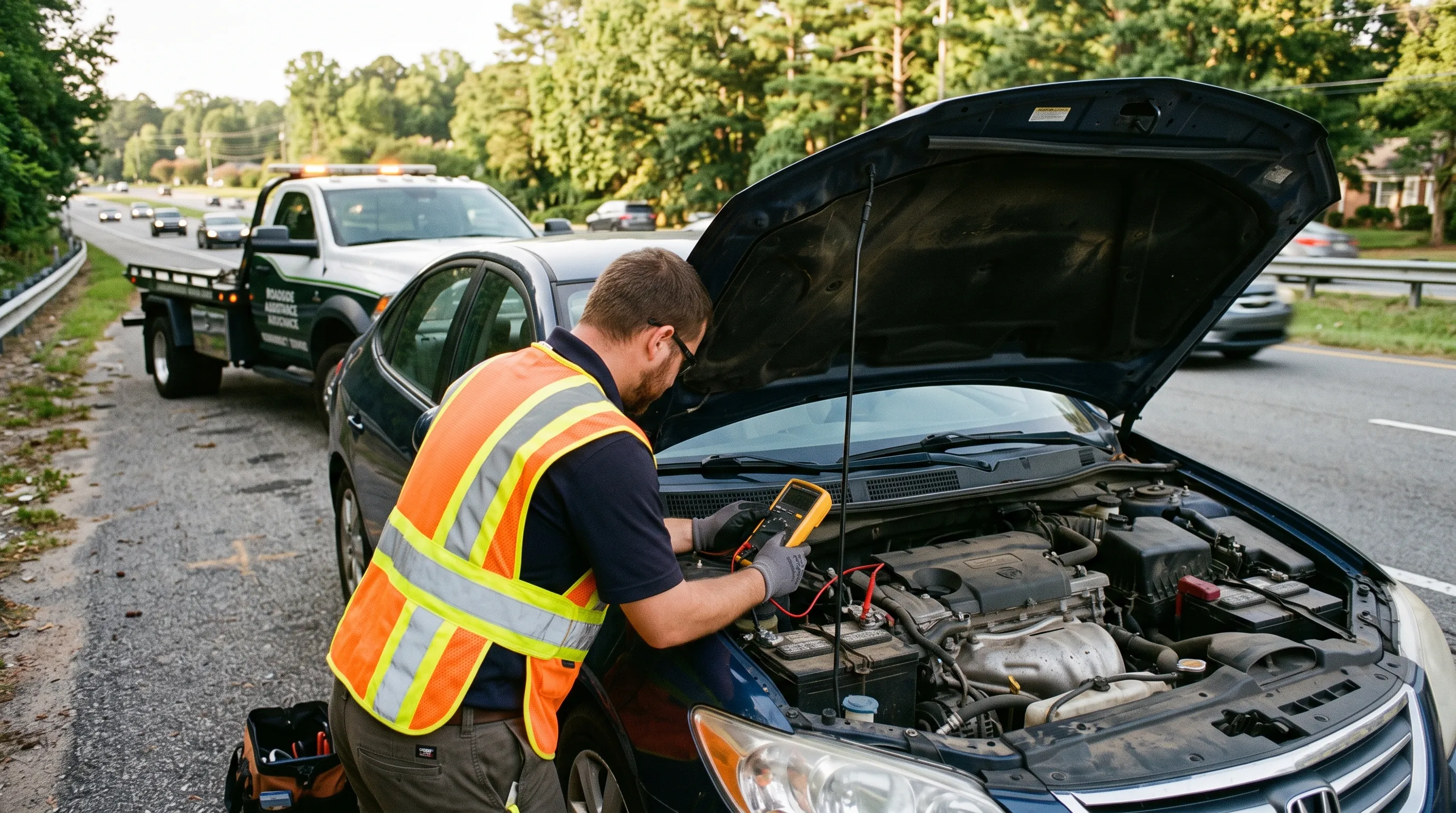
The fix is simple: if your battery is more than three years old, get it load-tested. Most auto parts stores do this for free in a few minutes, and it tells you exactly where the battery stands instead of leaving you to guess. If you’re already seeing slow starts, don’t wait for it to die completely, replace it on your schedule instead of the battery’s. If it does die on you anyway, a jump start is part of our roadside assistance service, and most jump-start calls end with you driving off yourself, no tow needed.
Worn or under-inflated tires
A flat rarely happens without warning. Slow leaks show up as a tire that needs air every couple of weeks, a pull to one side, or a tread that’s visibly thinner than the others. Under-inflated tires also run hotter and wear faster, which turns a slow leak into a blowout risk over time, especially on the long interstate stretches around I-385 and I-85 where tire failures happen at highway speed.
Two numbers matter here: tread depth and pressure. Tread below 4/32” is the point to replace, not wait, a quarter dropped into the tread groove with Washington’s head down is a rough at-home check. Tire pressure should match the number on the driver’s-door sticker, not the number printed on the tire’s sidewall, and it’s worth checking monthly since tires lose roughly 1 PSI per month even with no leak at all. A blowout on the interstate is a different situation than a flat in a driveway, and it’s exactly the kind of call our 24-hour emergency towing service is built to run any hour, any day.
Overheating
An engine running hot almost always shows a warning before it strands you: the temperature gauge creeping toward the red, a sweet smell from the dash vents, or steam under the hood. Low coolant is the most common cause, and it’s also the easiest one to catch, checking the coolant reservoir level takes under a minute when the engine’s cold. A worn radiator hose or a failing thermostat can cause it too, and those are worth a mechanic’s look if the reservoir’s already full and the car still runs hot.
If your temperature gauge starts climbing, the single most important thing is to stop driving on it. Continuing to drive an overheating engine can turn a simple coolant top-off into a blown head gasket, a repair bill in a completely different category. Pull off at the next safe exit or shoulder, shut the engine off, and call rather than trying to nurse it the rest of the way home.
A five-minute before-you-drive checklist
None of this requires a mechanic’s toolbox. Once a season, or before a long drive, run through this:
| Check | What you’re looking for |
|---|---|
| Battery age | Over 3 years old, or slow to crank? Get it load-tested. |
| Tire tread | Below 4/32”? Replace rather than wait. |
| Tire pressure | Matches the driver’s-door sticker, checked monthly. |
| Coolant level | Reservoir full when the engine’s cold. |
| Warning lights | Any new dashboard light gets checked, not ignored. |
What to do if one of these catches you anyway
Even a well-maintained car breaks down sometimes, that’s not a failure on your part, it’s just mechanical reality. If a battery dies, a tire goes flat, or your engine starts running hot, pull off the road safely first, then call. Tell dispatch what’s happening, slow crank versus no crank at all, a flat versus a blowout, a gauge creeping up versus already in the red, that detail helps us send the right help the first time, whether that’s a jump, a tire change, or a flatbed tow if the car shouldn’t be driven any further.
Frequently asked questions
What’s the single most common roadside call? A dead battery. It’s the most common breakdown cause nationally and the one we see constantly, and it almost always gives warning signs, slow cranking, dim lights, weeks before it fails completely.
How do I know if my tires are actually a risk, not just old? Two numbers: tread depth below 4/32” and pressure that doesn’t match your driver’s-door sticker. Either one on its own is worth addressing before a long drive, not after a flat.
My temperature gauge is climbing but hasn’t hit the red yet. Should I keep driving? No. Pull off at the next safe exit and stop the engine. Continuing to drive on rising heat is how a coolant top-off turns into a much bigger repair.
Do these checks actually prevent a breakdown, or just reduce the odds? Reduce the odds, significantly. A battery, tire, or cooling problem caught early gets fixed on your schedule, in a driveway or a shop, instead of on a shoulder. Nothing eliminates every breakdown, but most of what we get called for gave a warning sign first.
The bottom line
Most of the roadside calls we run in Mauldin trace back to one of three things, a battery, a tire, or an overheating engine, and all three usually warn you before they strand you. A five-minute check once a season catches most of it. If one gets you anyway, roadside assistance is a phone call away, day or night, no surprises on the price and no runaround on the wait.